
A report released in December by the French communications regulator ARCOM says that rights-holders there have lost an estimated €1.5 billion in revenue – 12% of the legitimate audiovisual market, not including costs associated with technical interventions implemented by rights holders and ISPs. For the sports sector alone, losses are estimated at €290 million, which represents 15% of that market segment. Costs to government, including lost tax revenue, added a further €400 million
The report recommends three categories of action to help remedy the situation: simplify regulation and introduce automated enforcement, evolve to a more universal regulatory model that involves the entire digital ecosystem that includes advertisers and distribution services; and make greater use of criminal law and leverage the EU’s Digital Services Regulation to target illegal services.

Successes to date
Since 2009, France has incrementally introduced a system of laws, legislative directives, consumer education and anti-piracy interventions which are detailed in the report. The report details all of the regulatory and legal remedies available to ARCOM and to rights holders, with real-world examples.
Some are effective, while others have room for improvement. One example of the latter is that when a pirate is reported, it can take as much as 12 months to investigate the offense, collect evidence, and add the offender to a watch list.
Together, these measures have been at least partially responsible for an 80% decrease in peer-to-peer file sharing over the sixteen-year period since the measures were put in place; from 8.3 million users in 2009 to 1.3 million in 2025. A dynamic injunction mechanism introduced against illegal sports broadcasts and mirror sites in 2021 had reduced audiences for illegal sources by 35% from 2021 to 2025.
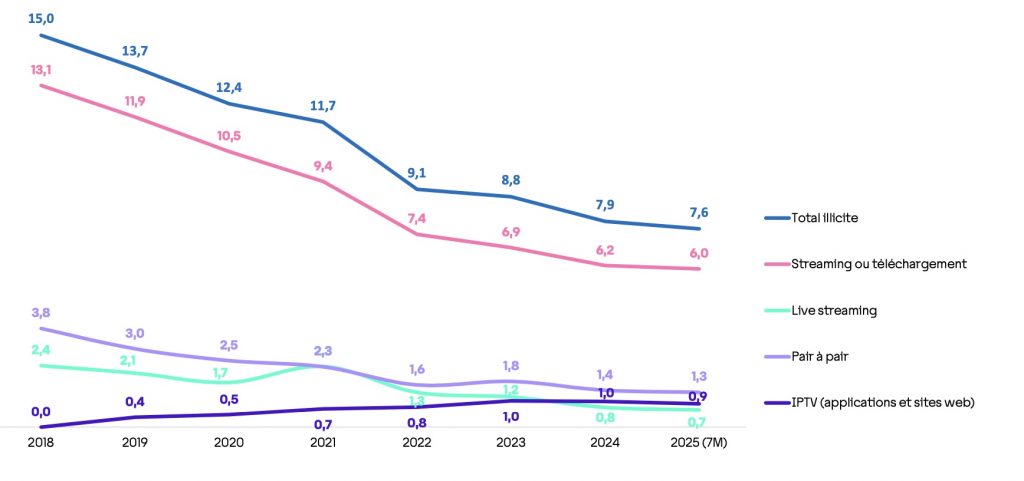
In addition, more than 13,000 domains have been blocked since 2022.
Practices across Europe
As is the case in France, several EU Member States have chosen to implement a mixed system to combat the piracy of online sports content. Some countries focus on administrative procedures while others use the legal system. Some use both. Others rely on voluntary measures. The report describes aspects of blocking regimes that are in place in Belgium, Italy, the UK, Germany, Denmark, Lithuania, Spain, Portugal, Greece and in other countries.
Piracy evolves and so must the countermeasures
Even with the availability of high-quality and affordable legitimate offerings, and regardless of countermeasures available in France’s judicial and administrative countermeasures such as site blocking based on Article L. 336-2 of the French Intellectual Property Code (CPI), streaming and direct downloading from illegal sources remains high.
While peer-to-peer downloading has declined, pirates have moved to streaming via mirror sites and change domain names to evade blocking. ARCOM says that the use of illegal IPTV services has grown to 11% of French Internet users. Two thirds of these users say they started three years ago or less.
ARCOM observed that several modes of illicit consumption coexist today: via streaming, direct download, peer-to-peer download (P2P), live streaming, use of illicit IPTV (directly on websites and applications or via dedicated illicit streaming devices), illegal distribution via social networks, and via cloud services.
The continuous emergence of new use-cases has resulted in new and increasingly sophisticated methods to circumvent existing blocking systems. Access to illegal sources via VPNs and encrypted DNS queries are practiced by nearly half of consumers ages 15-24. Overall, VPN and alternative DNS services are used by 35% of French Internet users for personal purposes, and 14% use both.
The following table identifies the blocking approaches requested by various sports organizations. “FAI” = “ISP.” “Moteurs de recherche” = “Search engines.”
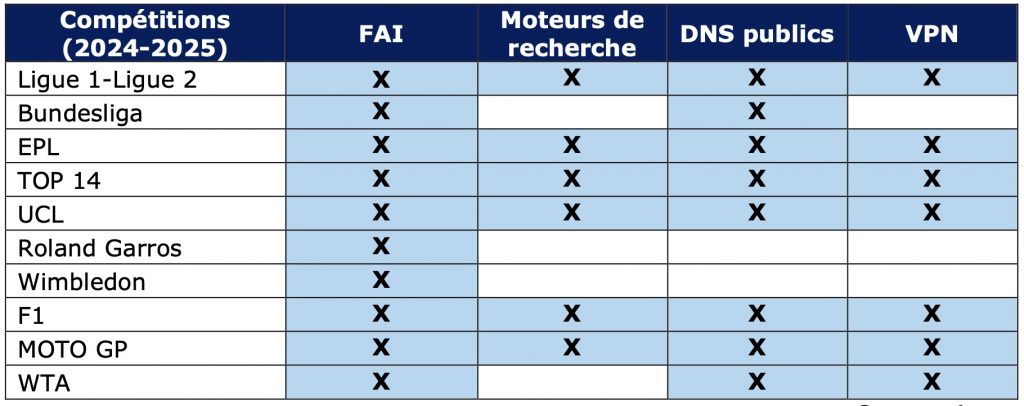
ISPs and search engine operators that have signed a blocking agreement with ARCOM implement the measures within minutes of being notified. In other cases, it takes about three working days for search engine operators on average.
ARCOM conclusions
Without changing the law, France’s current legislative and regulatory framework could impact the effectiveness of anti-piracy actions, as the current system is not perfectly suited to combat live piracy. Also, automation of part of this system may become necessary to meet the rapid takedown expectations of the live sports sector.
ARCOM has operated an internal information system since June 2024 which automates the receipt of complaints, part of their processing, and the deployment of blocking measures, particularly in the evenings and on weekends. This system has improved the processing of complaints and consequently increased the number of blocked domain names. If this is to form the basis for an automated platform, France can look to Italy’s Piracy Shield system as it formulates its own implentation and best-practices.
Why it matters
The Regulator finds that existing countermeasures which combine technological, legal and administrative actions have helped protect cultural and sporting content, but also that threats remain high and that anti-piracy practices by public authorities must continue to evolve. Alternate DNS providers and VPNs have been less responsive.
The total cost (public spending) of implementing the various anti-piracy measures recommended by ARCOM was estimated at around 2.2 million euros in 2024. But this must be analyzed in light of the revenue lost due to piracy, which amounts to €1.5 billion (excluding lost tax revenue). The cost also represents less than 4% of ARCOM’s budget.
Further reading
The challenges and various tools for combating piracy in the cultural and sporting sectors (Les enjeux et les différents instruments de lutte contre le piratage dans les secteurs culturels et sportifs). Report. December 1, 2025. by Carole Hentzgen. ARCOM (Authority for the Regulation of Audiovisual and Digital Communication, France)