

This is Data Privacy Week (Jan 26-30, 2026), an international effort hosted by the National Cybersecurity Alliance (NCA) that’s intended to raise awareness and provide tools to “respect privacy, safeguard data and enable trust.”
NCA puts it succinctly: “Your online activity creates a treasure trove of data. This information ranges from your interests and purchases to your online behaviors, and it is collected by websites, apps, devices, services, and companies all around the globe. This data can even include information about your physical self, like health data – think about how an app on your phone might count how many steps you take.”

Coinciding with this theme, the researcher YouGov released a report based on a years’ worth of consumer responses regarding their perceptions of – and the need for – privacy.
Key YouGov findings
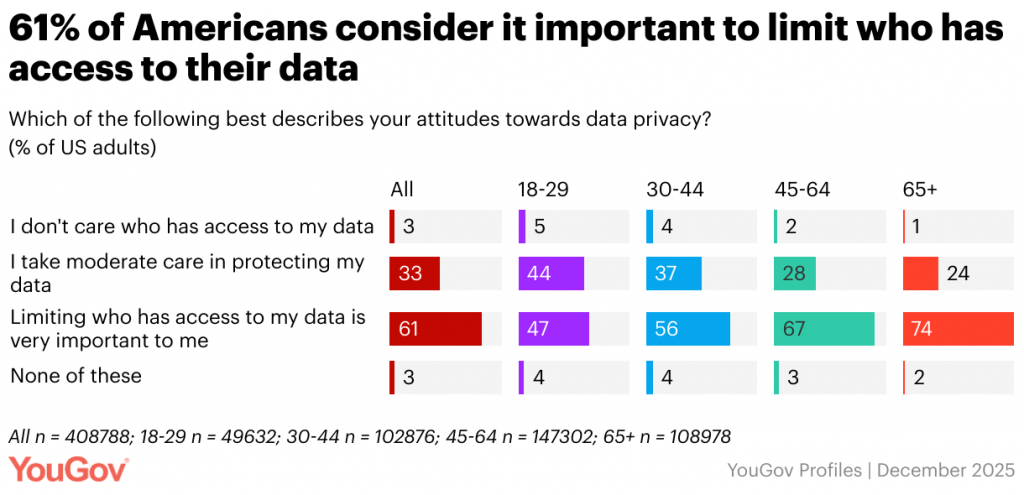
Older Americans care more about limiting commercial access to personal data, and yet, that demographic has the lowest rate of care in protecting personal data.
- 61% of Americans say limiting access to their personal data is very important, but 33% admit to taking only moderate care in protecting it.
- 56% are concerned that wearable devices could reveal personal lifestyle details to companies, making wearables a top data privacy concern.
- Younger adults (18–29) are less concerned (47%) about protecting their privacy and more likely to believe privacy worries signal “something to hide” (27%).
By age:
- 74% of those 65+ say limiting access is very important, compared with 61% overall.
- Younger adults (18–29) are the least likely to say limiting access is very important (47%), but they’re the most likely to say they take moderate care in protecting their data (44%).
Concerns around technology and devices
Concerns about 5G exist, but they don’t dominate in the same way. Four in ten (40%) say they have concerns about 5G and their data privacy, and 38% worry about safety risks if 5G technology fails.
One in five (20%) agree that people only worry about personal data online if they have something to hide. That suggests privacy isn’t only a technical or political issue, it’s also a cultural one, where concern can be judged as suspicious rather than sensible.
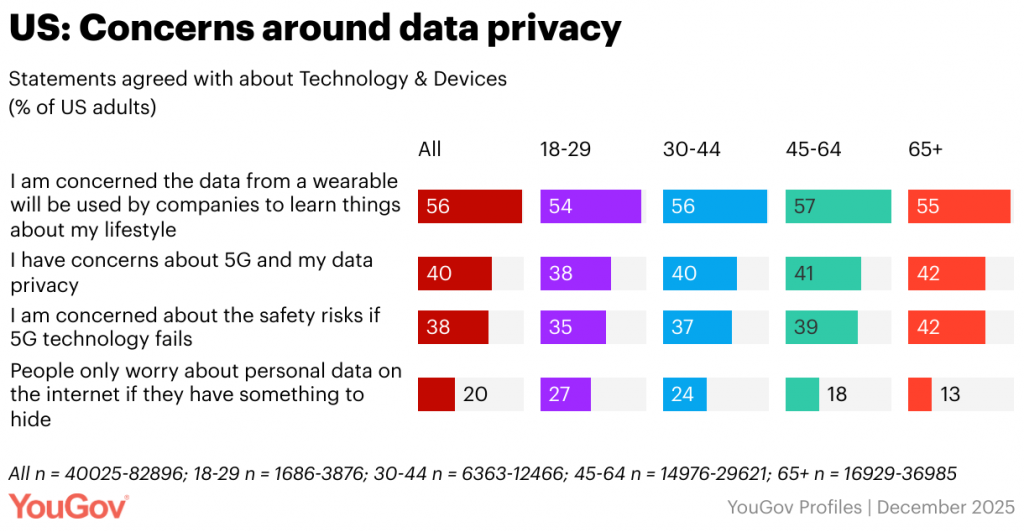
When you move from general attitudes to specific tech anxieties, one theme stands out: Americans seem most uneasy when data gets personal and continuous. A majority (56%) worry that data from a wearable device will be used by companies to learn things about their lifestyle.
Methodology
Figures are drawn from responses by more than 400,000 consumers, collected between December 2024 and December 2025, using a 52-week dataset updated weekly. Data is nationally representative of adults (18+) in the US and weighted by age, gender, education, region, and race. YouGov Profiles is based on continuously collected data through rolling surveys, rather than a single limited questionnaire.
What can you do?
NCA makes a range of common-sense suggestions that most modern consumers can appreciate and implement:
- Manage your privacy settings
- Take control of personal data
- Respect privacy
- See what others are doing (Be a champion)
Why it matters
Concerns about privacy are next door neighbors to those about piracy because poor privacy protections open the door to pirates who do not have your best interests in mind. Data Privacy Day and Week are designed for consumer awareness of the issues and ways to reduce personal security risks
The YouGov data suggests Americans do want control over their personal data, but they don’t always feel equally equipped (or equally motivated) to enforce it.
Together, the data finds that most people want stricter control, many feel exposed by wearable data, and age shapes whether privacy feels like a right to defend or a risk to manage.
Further reading
Data privacy day US 2026: How concerned are Americans about data security? Press release. January 13, 2026. YouGov
Data Privacy Week (https://staysafeonline.org). Web landing page. Accessed January 26, 2026. National Cybersecurity Alliance