

The annual Special 301 Report identifies unfair trade practices in foreign markets, including barriers with respect to intellectual property (IP), as a top trade priority for the US government. The Special 301 Subcommittee in the Office of the US Trade Representative received stakeholder input on more than 100 trading partners, to identify whether a particular trading partner should be identified as a threat to US intellectual property.
The report notes that technological developments have made the Internet an extremely efficient vehicle for disseminating pirated content that competes unfairly with legitimate e-commerce and distribution services that copyright holders and online platforms use to deliver licensed content.

Consequently, online piracy is the most challenging copyright enforcement issue in many foreign markets. For example, during the review period, countries such as Argentina, Canada, Chile, China, Colombia, Ecuador, Guatemala, India, Mexico, Pakistan, Poland, Russia, Switzerland, Thailand, and Vietnam had high levels of online piracy and lacked effective enforcement.
Streaming piracy
Stream-ripping has become a dominant method of music piracy, causing substantial economic harm to music creators and undermining legitimate online services. During the review period, stream-ripping was reportedly popular in countries such as Canada, Chile, India, Mexico, Nigeria, Russia, and Switzerland.
The report recognizes that there are many illegal IPTV services, many of which are subscription-based, for-profit services with vast and complex technical infrastructures. Stakeholders continue to report notable levels of piracy through Illicit Streaming Devices (ISDs) and illicit IPTV apps, including in Algeria, Argentina, Brazil, Canada, Chile, China, Guatemala, Hong Kong, India,Indonesia, Iraq, Mexico, Morocco, Singapore, Switzerland, Taiwan, Thailand, and Vietnam. China, in particular, is a manufacturing hub for these devices.
Signal theft
Signal theft by cable operators continues to be a problem. In most cases, infringers circumvent encryption systems or otherwise unlawfully access cable or satellite signals to access copyrighted content. Hotels remain common sites of this type of infringement as they may use their own on-site facilities to intercept programing services and retransmit them throughout the hotel without paying right holders. For example, in Brazil, signal theft is used as a source of premium live content. Similarly, Argentina’s law enforcement authorities do not prioritize prosecuting theft of pay-tv signals.
Other channels for piracy
In addition to the distribution of copies of newly released movies resulting from unauthorized camcording, the report recognizes other examples of online piracy that damage legitimate trade are found in virtually every country listed in the Special 301 Report. These include: the unauthorized retransmission of live sports programming online; the unauthorized cloning of cloud-based entertainment software through reverse engineering or hacking onto servers that allow users to play pirated content online, including pirated online games; and the online distribution of software and devices that allow for the circumvention of technological protection measures, including game copiers and mod chips that allow users to play pirated games on physical consoles.
Interestingly, the rise of artificial intelligence as an aid to conduct piracy, as well as it’s use as a tool to fight it, barely received a mention:
“Stakeholders have expressed views with respect to the use of copyrighted materials in the development of artificial intelligence (AI). The United States supports the development of legal frameworks for AI development that ensure copyrights are respected37 and supports voluntary licensing regimes for the use of copyrighted works. The United States continues to monitor copyright issues as the AI sector grows globally.”
Trading partners listed
Following extensive research and analysis, USTR has identified 26 trading partners. They are assigned into three categories: Priority Foreign Countries (PFCs), Priority Watch List entries, and Watch List entries.
The full list of countries analyzed in the report are:
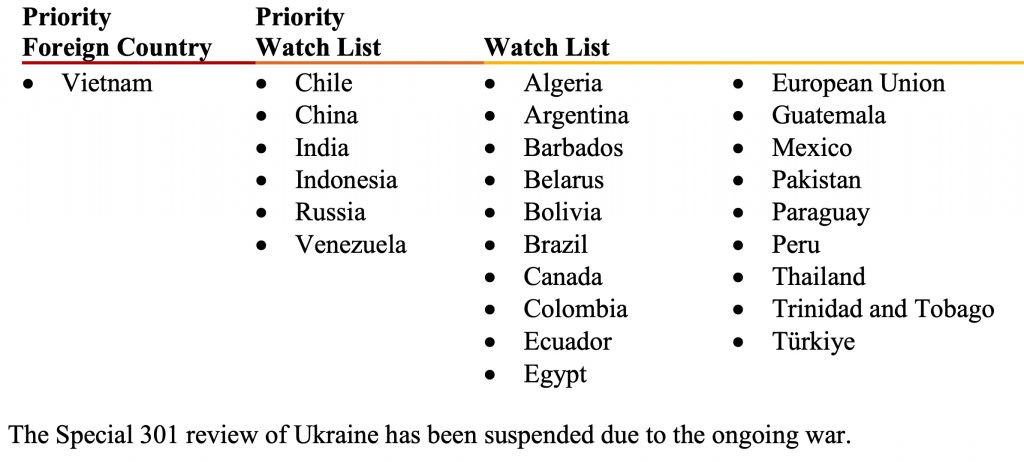
Vietnam was the sole Priority Foreign Country
For 2026, Vietnam was listed for five reasons: (1) failure to provide persistent and effective enforcement to combat online piracy; (2) failure to provide sufficient enforcement against widespread counterfeiting; (3) lack of effective border enforcement; (4) lack of enforcement actions against unlicensed software use; and (5) lack of criminal measures against cable and satellite signal theft.
Vietnam continues to host popular English-language copyright infringement sites and services that target a global audience. Some of these sites provide piracy services, including extensive libraries of pirated movies and TV shows. A locally popular cyberlocker offering such services also operates within Vietnam. The operators of these sites and services likely based themselves in Vietnam because enforcement efforts there historically lacked the follow-through and substantial penalties needed to deter infringement.
For example, after the successful shutdown of Vietnam-based video hosting site 2embed in July 2023 after engagement from right holders, the domain MegaCloud replaced this site and continued its piracy operations in Vietnam. Stakeholders report that Vietnam has the highest incidence of online piracy in the Asia-Pacific region, has high levels of music piracy, and is ranked eighth in the world for piracy of certain mobile video games.
Despite having criminal laws that provide for substantial fines and years of incarceration for copyright infringement, defendants in recent criminal prosecutions in Vietnam received suspended sentences and were only ordered to pay relatively low financial penalties.
For example, in the case against the operators of Fmovies, one of the most popular piracy sites in the world, the court, over the objection of prosecutors, imposed suspended sentences on both defendants and only ordered them to pay around $2,700 and $770 in criminal fines, respectively, and around $35,000 to compensate right holders.
Vietnam’s continued reliance on administrative enforcement actions over civil or criminal enforcement has been another long-standing concern, particularly as administrative enforcement does not have the same deterrent effect as civil remedies and criminal penalties.
Background about the report
The Special 301 report characterizes the use of all possible tools to address unfair trade practices in foreign markets, including barriers with respect to intellectual property (IP) as a top trade priority for the US government. This means pressing trading partners for robust standards of IP protection so that Americans can secure rights to their IP, such as inventions, creations, and brands. Equally important is having effective enforcement regimes for IP rights in the courts, by law enforcement, and at the border so that U.S. owners of IP can defend their rights when their IP is stolen or infringed and so that the benefits can flow back to the United States economy.
The Report is the result of an annual review of the state of IP protection and enforcement in U.S. trading partners around the world, which the Office of the United States Trade Representative (USTR) conducts pursuant to Section 182 of the Trade Act of 1974, as amended (the Trade Act, 19 U.S.C. § 2242). Congress amended the Trade Act in 1988 specifically “to provide for the development of an overall strategy to ensure adequate and effective protection of intellectual property rights and fair and equitable market access for United States persons that rely on protection of intellectual property rights.”
Why it matters
The US Congress expresses concerns that “the absence of adequate and effective protection of United States intellectual property rights, and the denial of equitable market access, seriously impede the ability of the United States persons that rely on protection of intellectual property rights to export and operate overseas, thereby harming the economic interests of the United States.”
Further reading
2026 Special 301 report. Research report. Released April 30, 2026. Office of the US Trade Representative