

The plaintiffs, Sony, EMI (Universal Music Group), Warner, and numerous subsidiaries, pulled no punches in their claims against Anthropic, CEO Dario Amodei and co-founder Benjamin Mann as “the culprits behind one of the largest and most blatant ongoing thefts of intellectual property in history.”
The Complaint, filed August 28 2026, accuses the Defendants as having “unlawfully acquired troves of Music Publishers’ musical compositions, and then systematically copied those works multiple times, including as the inputs to train Anthropic’s Claude AI models and in the outputs those models generate.”

The Complaint identifies four counts of infringement:
- Direct Copyright Infringement by Torrenting (Against All Defendants),
- Contributory Infringement by Torrenting (Against Anthropic CEO Dario Amodei and Co-founder Benjamin Mann),
- Direct Copyright Infringement (Against Anthropic), and,
- Removal or Alteration of Copyright Management Information (Against Anthropic).
A huge trove
“Discovery will reveal the full extent to which Anthropic’s users and customers rely on Claude to generate market substitutes to Music Publishers’ works,” said the music publishers’ complaint.
The Complaint included the 20-page Exchbit A, listing “books that Defendants torrented from … pirate websites … containing the lyrics and sheet music to hundreds or more of Music Publishers’ copyrighted musical compositions.
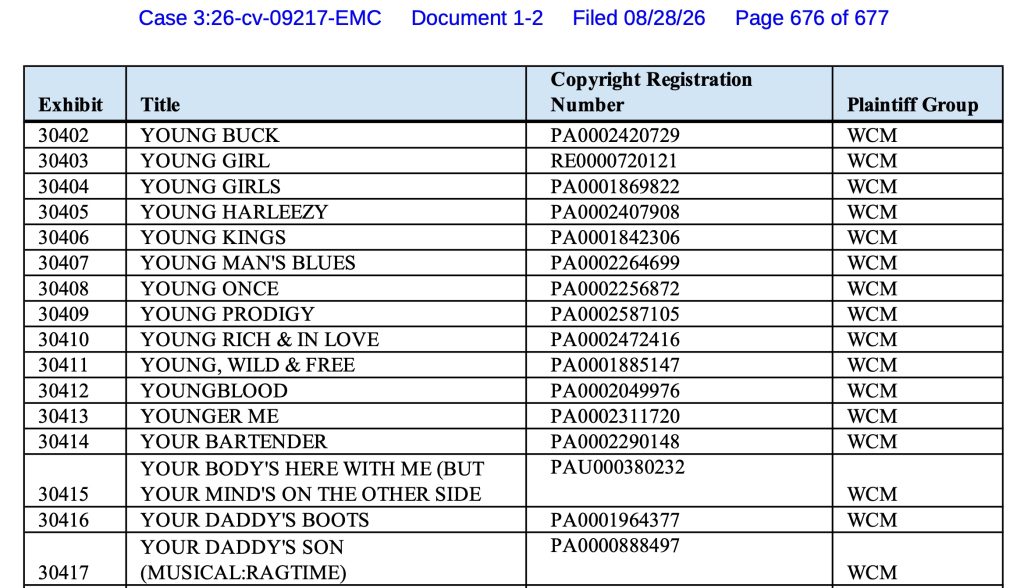
The 677-page Exhibit B lists “works that Anthropic unlawfully copies as training input (which includes) tens of thousands of Music Publishers’ copyrighted musical compositions.”
Citing precedent
The Complaint went on to say that the “Defendants can no longer hide their extraordinary theft, and their mass infringement is now well-documented. Another court in this District recently described Anthropic’s actions as “straightforward piracy but at massive scale.” Bartz v. Anthropic PBC, 791 F. Supp. 3d 1038, 1064 (N.D. Cal. 2025) (“Bartz I”).
“Anthropic torrented millions of books from two so-called “pirate libraries,” notorious for containing vast collections of illicitly obtained content: LibGen and PiLiMi,” said the Complaint. “Defendants’ torrenting conduct began in June 2021, when (Co-founder) Mann personally used “the infamous BitTorrent protocol” to unlawfully torrent via BitTorrent at least five million books from LibGen.”
In that case, the content included “including at least hundreds of songbooks and sheet music containing the lyrics to hundreds or more of Music Publishers’ copyrighted works,” plus coyright management information (CMI = metadata) that enables users and licensees to identify music titles and authors of the works.
“Music Publishers typically require licensees to display CMI, and its removal by unlicensed third parties violates Music Publishers’ rights and harms their interests and those of their songwriters,” said the Complaint.
Ethics aside
Anthropic has positioned itself as an “ethical AI company,” with a “focus on safety” that included a mandate to “to stop training and refuse to deploy an AI system if it could not guarantee it had proper safety guardrails in place that met stringent internal standards.”
But the Complaint claimed that Anthropic employees and executives increasingly set these ethics aside in the face of competitive pressures: “We didn’t really feel, with the rapid advance of AI, that it made sense for us to make unilateral commitments . . . if competitors are blazing ahead,” said Anthropic’s founder and Chief Science Officer Jared Kaplan.
Potential damages
After Anthropic was found, in the above-cited Bartz case, to have illegally torrented over seven million copyrighted books – including published sheet music – from the notorious online pirate websites known as Library Genesis (“LibGen”) and Pirate Library Mirror (“PiLiMi”), Anthropic settled that copyright infringement class action for $1.5 billion.”
In this Sony / Warner et al case, the Plaintiffs may aim higher, noting that Anthropic’s pre-IPO market valuation has been estimated as high as $2 trillion. The statutory maximum per work infringed for rights-violation is $150,000, plus $25,000 per violation from Anthropic’s “removal and/or alteration of Music Publishers’ copyright management information (CMI).
Whether the Plaintiffs get that much in damages is an open question. In a recent case, Meta Platforms was sued for $2 trillion, for producing software that intentionally caused children to become addicted to Facebook and other Meta products. The reasoning was that the amount would significantly damage the company’s market valuation. The ultimate settlement was $18 billion.
Why it matters
This case is another chapter in the years-long ongoing battle by rights-holders against AI platform providers, for using unlicensed content to train their large language models.
Microsoft, OpenAI and others claim that the use of copyrighted content constitutes “Fair Use” by transforming original works to an extent that AI results are not direct copies and therefore are not substitutes that detract from the value of the original works. Rights holders counter that creative works are strongly protected and and if they are not licensed by the AI platform companies, those companies profit from the works illegally.
Further reading
Sony Music Publishing (US) LLC, Warner Chappell Music Inc., et al, Plaintiffs, v. Anthropic PBC, Dario Amodei, and Benjamin Mann, Defendants. Complaint and demand for jury trial. Document 1, Case 5:26-cv-09217. US District Court Northern District of California San Jose Division.