

Three creators that publish videos on YouTube claim that nVidia used their content to train nVidia’s Cosmos AI model, without authorization from the publishers.
Ted Entertainment, Mattt Fisher and Golfaholics, Inc., allege that nVidia “unlawfully circumvent(ed) technological measures to access and scrape millions of copyrighted videos from the online video viewing platform, YouTube, in order to feed, train, improve, and commercialize (nVidia’s) large-scale generative artificial intelligence (“AI”) foundational model named “Cosmos.”

Cosmos is a foundational model that is designed to underpin and support solutions across nVidia’s product and services portfolio. These include GeForce hardware and cloud gaming, Avatar cloud middleware for digital personas, GR00T humanoid robotics, DGX Cloud AI service platform, GPU Arch graphics software platform, DL deep learning frameworks and AI-driven autonomous vehicle systems.
Basis for the lawsuit
The plaintiffs contend that nVidia’s violates the provisions of the Digital Millennium Copyright Act (DMCA) regarding anti-circumvention (§1201) by bypassing technological protection measures that control access to copying of YouTube videos.
They seek statutory damages, injunctive relief, restitution, and all other remedies allowed by law pursuant to the DMCA, 17 U.S.C.A. § 1201(a), commensurate with the scope of infringement. A jury trial was requested.
What is the content in question?
All three plaintiffs contend that they have invested substantial time and money into producing their works and bringing awareness around it
- Ted Entertainment, Inc. is an independent content creator which owns and operates YouTube channels “h3h3 Productions” and “H3 Podcast Highlights,” with more than 5,800 original videos on YouTube, with a combined total of over 4,000,000,000 YouTube views and more than 2,600,000 subscribers.
- Plaintiff Matt Fisher is an individual creator and California resident who posts golf videos on YouTube, many of which are instructional. His Mr.ShortGame YouTube channel has over 500,000 subscribers and hundreds of millions of views.
- Golfholics is a California corporation with a golf channel that has 130,000 subscribers and has had millions of views.
Intentional infringement?
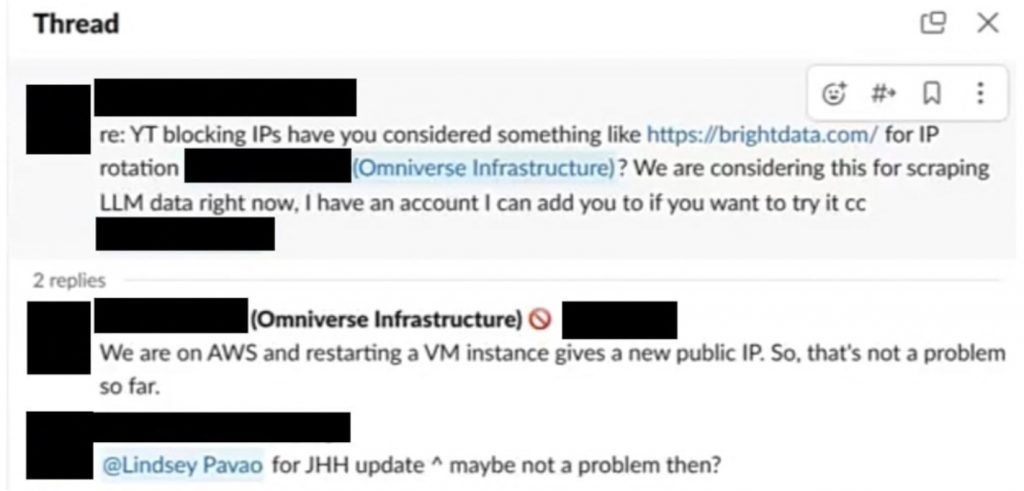
nVidia was said to use a video-downloading program combined with virtual machines that rotated IP addresses to avoid detection and blocking; which enabled the “mass extraction of, at times, eighty years of video content per day.”
Internal conversations detailed in the Complaint demonstrate that nVidia personnel were aware of the protections and actively worked toward circumventing them
Even though the videos are not explicitly registered with the US Copyright Office, US law says that copyright registration is not a prerequisite for protection against unlawful circumvention of access controls.
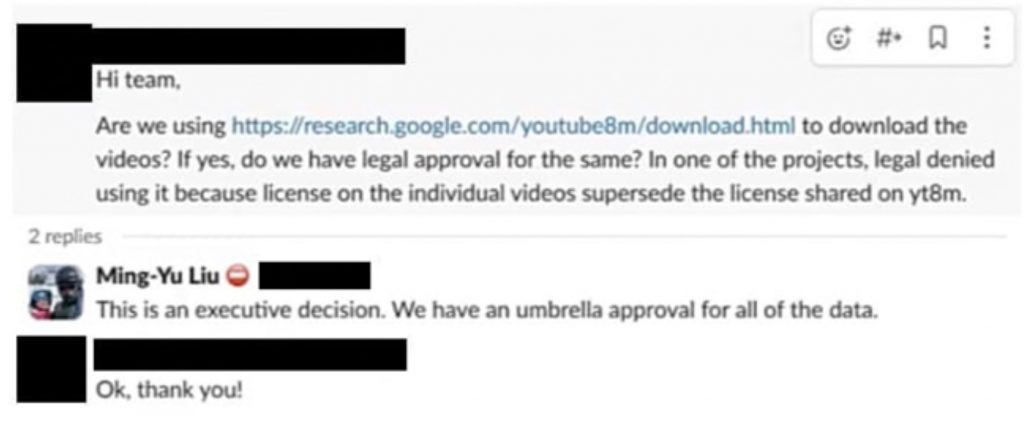
An nVidia employee questioned whether the practice was legal, and was told that “umbrella approval” was an executive decision.
The plaintiffs recognized that the stakes are high, saying that nVidia conducted “an unconscionable attack on the community of content creators whose content is used to fuel the multi-trillion-dollar generative AI industry without any compensation. Once ingested, the plaintiffs allege that nVidia stores it in its “neural network” which prevents it from being deleted.
Nature of the Class
The three Plaintiffs in this Complaint proposed the creation of a Class of plaintiffs defined as “All individuals and entities in the United States who uploaded original videos to YouTube and whose videos (or material portions thereof) were included in the HDVILA-100M, HD-VG- 130M, and HowTo100M datasets used by Defendant to train, refine or otherwise improve its generative AI models.”
Like the Plaintiffs, the Class Members in this case would be independent content creators who uploaded their video content to YouTube’s video platform. The video content of Class Members was also part of the dataset utilized by Defendant to train its foundational AI model.
However, whether or not this Class will actually be created and enforced is as yet undetermined.
Why it matters
The plaintiffs allege that nVidia intentionally bypassed restrictions that YouTube has in place to enable viewing only through streaming, preventing access to the source video files; by deploying scraping tools designed to evade YouTube’s access protections, which violates the Digital Millennium Copyright Act.
If Class status is granted to anyone who has posted a video that they created to YouTube, nVidia’s financial responsibility could become enormous.
Further reading
Ted Entertainment, Matt Fisher and Golfholics, Inc. Plaintiff, v. nVidia Corporation, Defendant. Document 1 (Class Action Complaint). Case no 3?25-cv-10287. Filed November 26, 2025. US District Court for the Northern District of California