

Plaintiffs Elsevier, Cengage, Hachette, Macmillan, McGraw Hill, and author Scott Turow filed a Complaint in a New York US District Court against Meta Platforms and Mark Zuckerberg – proposing that it become a class action suit. The defendants are accused of obtaining and using millions of copyrighted works to train Meta’s LLaMA large language model without permission, and for removing their copyright management information. The plaintiffs demand a jury trial.
The Complaint alleges that “Defendants Meta and Zuckerberg followed their well-known motto: “move fast and break things.” They first illegally torrented millions of copyrighted books and journal articles from notorious pirate sites and downloaded unauthorized web scrapes of virtually the entire internet. They then copied those stolen fruits many times over to train Meta’s multi-billion-dollar generative AI system called Llama. In doing so, Defendants engaged in one of the most massive infringements of copyrighted materials in history.”

Pulling no punches, a prepared statement by the Association of American Publishers (AAP) said that the lawsuit is “a unified effort by companies across the academic, education, and trade publishing sectors seeking to hold Meta and Zuckerberg responsible for their broadly damaging, self-interested misconduct.”
The complaint lists six violations:
Defendants’ violations of the Copyright Act, 17 U.S.C.
§§ 106(1) and 501, which include
- Reproduction by torrenting
- Reproduction via web scrapes
- Reproduction in training
- Distribution by torrenting
- Contributory infringement by Mark Zuckerberg, and,
Violations of the Digital Millennium Copyright Act, 17 U.S.C. § 1202(b) – removal and/or alteration of copyright management information
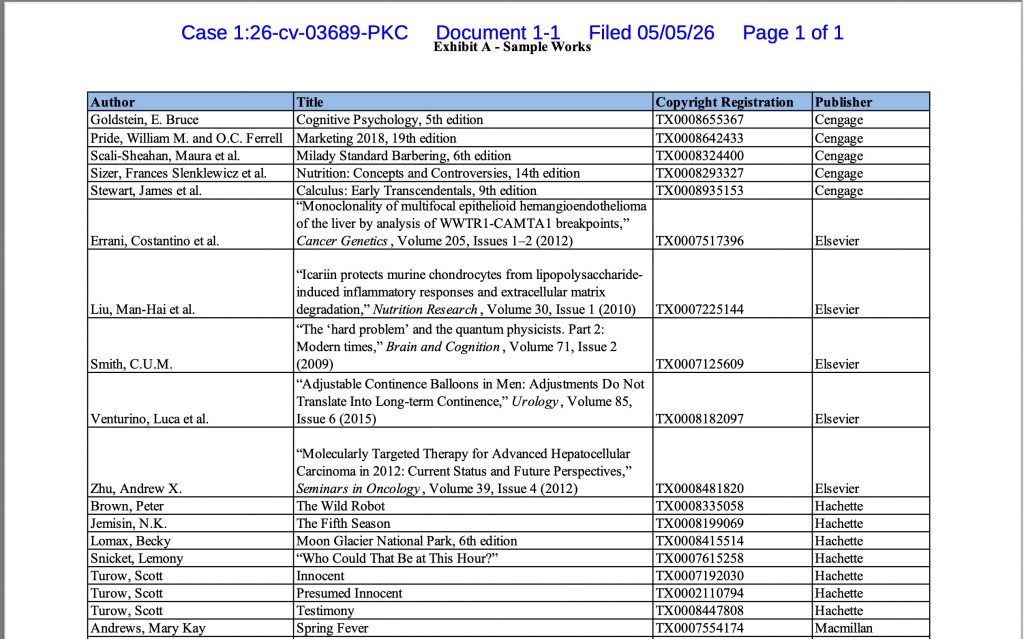
An “Exhibit A” to the Complaint identified some examples of the publishers’ works
Where could Meta use the works?
The AI models at issue in the litigation include all versions, iterations, and relatives of Llama (the “Llama Models”), including Llama 1, Code Llama, Llama 2, Llama 3, Llama 3.1, Llama 3.2, Llama 3.3, Llama 4, and Muse Spark. The AI-powered products at issue in this litigation include all versions, iterations, and relatives of products that incorporate, rely on, or otherwise use the Llama Models (the “Llama Products”), including Facebook, Instagram, WhatsApp, Messenger, HorizonAI, and the AI products created and distributed by Meta’s AI group, Meta AI, such as Meta’s AI glasses.
Not the first case of this type
While the AAP characterized it as the first lawsuit of its kind against Meta, a similar case was filed in February 2025 by three individual authors, who also proposed that they be recognized as part of a Class. Referred to as the “Kadrey case,” it also claimed that their copyrighted materials were copied and ingested as part of training LLaMA.
What the plaintiffs want
According to the Complaint, the publishers want the Court to rule that Meta pay the publishers and Class-members statutory damages in an amount up to the maximum provided by law, pursuant to 17 U.S.C. § 504(c); or alternatively, at Plaintiffs’ and the Class’s election, actual damages and Defendants’ profits from the infringement, in an amount to be proven at trial, pursuant to 17 U.S.C. § 504(b)
They also want an order requiring Meta to pay Plaintiffs’ and the Class’s statutory damages in an amount up to the maximum provided by law, pursuant to 17 U.S.C. § 1203(c); or in the alternative, at Plaintiffs’ and the Class’s election, actual damages in an amount to be proven at trial, pursuant to 17 U.S.C. § 1203(c)
In addition, the Plaintiffs want “an accounting of the training materials, training methods, and known capabilities of its Llama Models, including requiring that Defendants identify the books, journal articles, and other copyrighted works on which they have trained Meta’s Llama Models, and disclose the methods by which Defendants have collected, copied, processed, and encoded this training material (including any third parties it has engaged to collect or license such materials)”
Why it matters
This is another case in the ongoing high-stakes battle between rights-owners and AI platform providers; as to how the latter acquire, utilize and distribute copyrighted works.
Meta has been accused on multiple occasions of knowingly using copyrighted works to train its large language models. But in the Kadrey case referenced above, a judge ruled later in 2025 that Meta’s use was “fair use.” A decision regarding the distribution aspect of that case is still pending.
Further reading
Elsevier Inc, Cengage Learning Inc, MacMillan Publishing Group LLC dba MacMillan Publishers, McGraw Hill LLC, Scott Turow, and S.C.R.I.B.E., Inc. individually and on behalf of others similarly situated, Plaintiffs, v. Meta Platforms, Inc. and Mark Zuckerberg. Class Action Complaint for (five violations of the Copyright Act and violation of the Digital Millennium Copyright Act). Document 1, Complaint. Case 1:26-cv-03689-PKC. Filed May 5, 2026. US District Court for the Southern District of New York.
Publishers and authors file class action lawsuit against Meta and Zuckerberg for willful copyright infringement to develop Llama AI models. Press release. May 5, 2026. Association of American Publishers
Major publishers sue Meta for copyright infringement over AI training. Article. May 5, 2026. The Guardian
Employee statements claim Meta used pirated material to train LLaMA AI in Kadrey case. Article. February 17, 2025. by Steven Hawley. Piracy Monitor