

Research published in January by Lunio found the average invalid ad traffic (IVT) rate across all channels combined to be 8.51% in 2025, meaning that out of a total global ad-spend estimated at $740 billion dollars in 2025, $63 billion dollars were lost to invalid traffic.
IVT refers to any interaction that doesn’t stem from a genuine user with real intent. It includes bot activity, fraudulent engagement, automated scraping, and accidental clicks. While not always malicious, it’s always wasteful and represents a persistent threat to return-on-investment.

With US digital ad spend estimated to have exceeded $300B in 2024, an 8.44% IVT rate means more than $25B was spent driving traffic with no real conversion potential. In the UK, where annual digital ad spend surpassed $36B, the equivalent wasted advertising expenditure was estimated at $2.9B.
Invalid ad traffic that was below the 8.44% average occurred in Australia (7.87%), Western Europe (6.34%) and Canada (6.29%); still high.
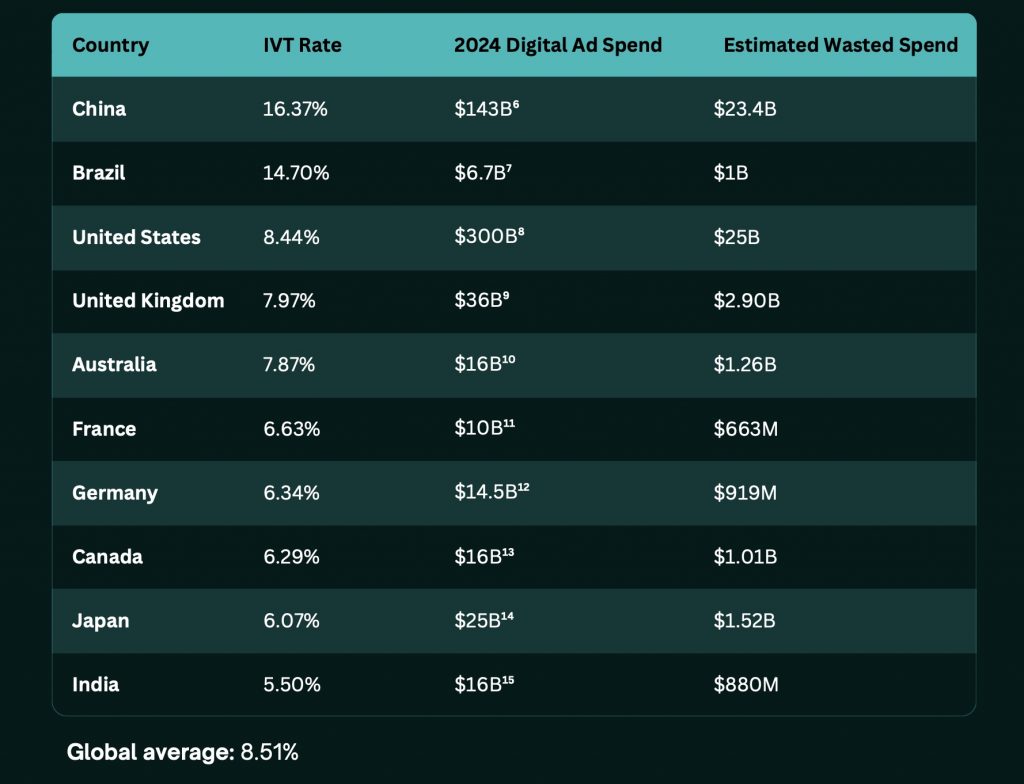
India was lowest, at 5.50%, which Lunio attributed to India’s being “a mobile-first, app-centric market.” App environments are said to be easier to validate than open web inventory, as opposed to markets with heavier desktop and open-display exposure; which tend to see higher IVT rates.
AI is becoming a new IVT driver
While automation and targeting using AI technologies does not in itself constitute fraud, AI-based agents will be used to conduct fraudulent campaigns on an increasing basis. AI platforms have become increasingly able to mimic online human behaviors, session patterns and natural use of language and therefore will be increasingly effective in evading detection.
Why it matters
Invalid traffic isn’t evenly distributed across markets. Some countries carry significantly higher baseline risk, and that risk compounds fast as ad expenditure increases.
Therefore, media teams planning international outreach need country-level visibility into what’s real, what’s automated, and what’s quietly draining budget.
Further reading
Ad Fraud: Which countries are worst affected? Article. January 21, 2026. by Ben Harris. Lunio
The Global Invalid Traffic Report 2026. Landing page to download report. January 2026. Lunio