

The European branch of the Computer & Communications Industry Association (CCIA Europe) warned that, as the World Cup tournament gets underway, EU and national policymakers should be congizant of errors by automated web-blocking systems that allow private parties to restrict access to online services without proper judicial oversight – and contain those errors.
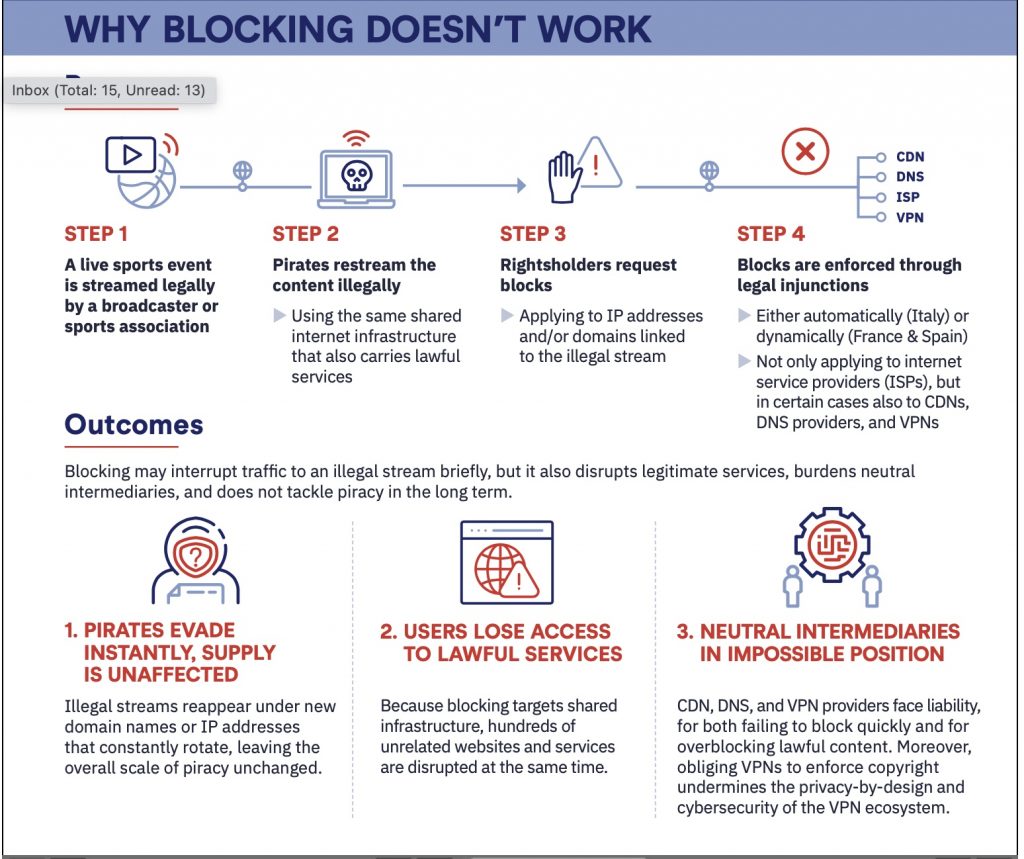
Many automated anti-piracy systems have come to rely on blunt blocking of Internet Protocol (IP) addresses and the Domain Name System (DNS), thereby undermining the Digital Services Act (DSA), disrupting lawful services, and infringing Europeans’ fundamental rights despite limited effectiveness.

To mark the tournament’s start, CCIA Europe is launching a new explainer (‘Fighting Piracy Without Breaking the Internet’) that details these risks, explaining why infrastructure-level blocking is a crude, disproportionate response to illegal sports streaming – concerns that are further substantiated by recent independent academic research.
Concerns seem justified
Recent anti-piracy plans announced by UEFA ahead of the World Cup, which seek to combine deeper online monitoring with dynamic blocking, risk scaling up the most problematic elements of national experiments already backfiring in France, Italy, and Spain.
In Spain, LaLiga uses a single limited court order to justify aggressive general IP-address blocking, with little transparency and no redress for wrongly blocked services.
Meanwhile, Italy’s automated Piracy Shield has repeatedly caused serious collateral damage by forcing ISPs, DNS resolvers, and VPN providers to implement IP and DNS blocks within just 30 minutes of receiving a complaint. France, meanwhile, has expanded blocking obligations even further, to proxy services and virtual private networks (VPNs).
Extensive impact
The result is widespread overblocking that routinely takes lawful businesses, educational platforms, public services, and cloud-hosted tools offline. It also pressures neutral intermediaries, including VPNs and CDNs, to take actions that are technically unworkable, legally questionable, or incompatible with their role in keeping the internet open and secure.
Why it matters
“The mistakes already visible in national blocking experiments should not be allowed to proliferate across the EU,” said Charlotte Dantin, Intellectual Property and Audiovisual Policy Manager for CCIA Europe. “When IP addresses are added to opaque blocking lists without continuous court review or meaningful redress, innocent businesses and users suffer. Piracy enforcement must target pirates, not the basic infrastructure that underpins the internet.”
Scaling these tactics across Europe during the World Cup would normalise privatised online censorship. CCIA Europe urges policymakers to defend the rule of law and the DSA by ensuring that no private organisation can block content without meaningful court scrutiny
“Major sporting events must not become a testing ground for private, automated censorship of internet infrastructure,” continued CCIA’s Charlotte Dantin. “Illegal streaming can and should be addressed, but enforcement must remain lawful, proportionate, and subject to independent judicial oversight.”
Further reading
World Cup anti-piracy measures must not undermine EU digital rights. Press release. June 11, 2026. Computer & Communications Industry Association (CCIA) Europe
Explainer: Fighting piracy without breaking the Internet – CCIA Europe. Infographic. June 11, 2026. Computer & Communications Industry Association (CCIA) Europe
Between effectiveness and fundamental rights: Sports piracy and the privatization of copyright enforcement in the EU. Research report (Landing page and abstract, link to report). Written April 11, 2026. Posted to SSRN April 29, 2026. By Joao Pedro Quintais, University of Amsterdam – Institute for Information Law (IViR) and Miguel Aznar, University of Valencia – Faculty of Law
Italy: Piracy Shield cited for ‘Indiscriminate’ blocking, evasion by pirates using IPv6. Article. October 1, 2025. by Steven Hawley. Piracy Monitor