
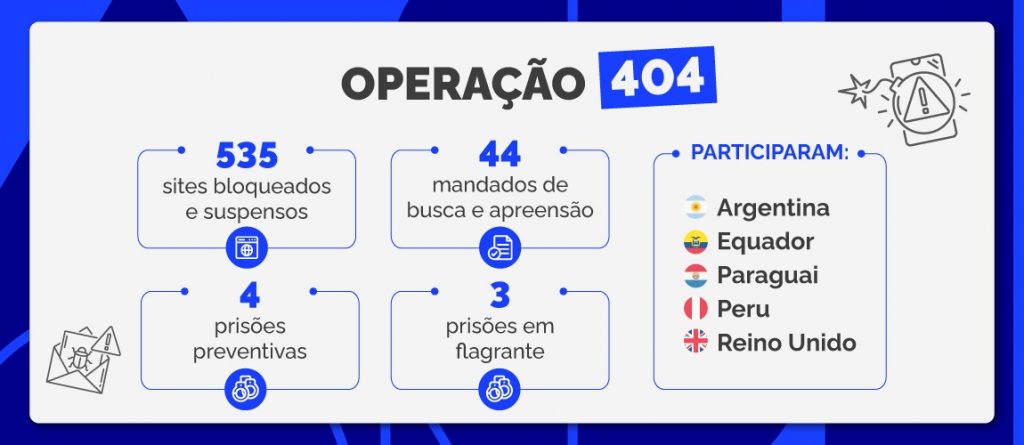
The 8th phase of Brazil’s ongoing Operation 404 anti-piracy initiative by law enforcement at the end of November was the largest international mobilization in the country, with the participation of Argentina, Ecuador, Paraguay, Peru and the United Kingdom and a host of government agencies and industry stakeholders.
Officials from Mexico and the United States acted as observers to know the methodology used in the anti-piracy operation.

Audio and video content, including games and music, are removed from availability online. In addition, 535 websites and an illegal streaming application were blocked and suspended, and thousands of pirated items were removed from online repositories and social networks. A total of 44 search and seizure warrants were executed across several Brazilian states, including four preventive arrests. Three arrests were made ‘in flagrante delicto’ (catching operators in the act).
The purpose was to identify and hold responsible the administrators and collaborators of the pirate platforms. This phase of Operation 404 expanded the focus, to penetrate the financing and monetization structures of these illegal services.
“This operation is a response of the Brazilian State to digital crime,” said Rodney da Silva, Director of Operations and Intelligence (Diopi), of the National Secretariat of Public Security (Senasp), of Brazil’s Ministry of Justice and Public Safety (MJSP). “At the current stage, it not only removes illegal content, but directly attacks the infrastructure and funding chain of piracy, showing that the internet is not a lawless territory. We will continue our work rigorously to protect intellectual property and the creative ecosystem.”
The name “Operation 404” is a play on the Web’s “404” error message, that a requested Web page could not be found.
In Brazil, the penalty for those who practice this type of crime is imprisonment of two to four years and a fine (Article 184, §3º of the Brazilian Penal Code). Those investigated may also be indicted for criminal association (Article 288 – CP) and money laundering (Article 1º – Law 9,613/1998).
Far-reaching collaboration
This action had the coordination of the Brazil Digital and Intellectual Property Office (DIOPI), through the General Coordination of Cyber Crimes (CGCiber-Ciberlab), and with the participation of the Civil Police of Alagoas (AL), Amazonas (AM), Bahia (BA), Ceará (CE), Espírito Santo (ES), Mato Grosso (MT), Minas Gerais (MG), Paraíba (PB), Paraná (PR), Pernambuco (PE), Rio de Janeiro (RJ), Rio Grande do Norte (RN), Rio Grande do Sul (RS), Santa Catarina (SC) and São Paulo (SP).
The MJSP also had the collaboration of multiple federal agencies in Brazil, including the National Telecommunications Agency (Anatel) and the National Cinema Agency (Ancine), which actively worked to block websites and domains that violated copyright in Brazil.
The first seven phases
Seven previous Operation 404 law enforcement actions have taken place over the years, roughly on an annual basis; beginning in 2019.
- Phase 1 – November 1st, 2019: 12 states and 30 search and seizure warrants, blocking of 210 websites and 100 illegal content streaming apps.
- Phase 2 – November 5, 2020: ten states and 25 search warrants, blocking 252 websites and 65 illegal content streaming apps.
- Phase 3 – July 8, 2021: eight states and 11 search and seizure warrants, blocking of 334 websites and 94 illegal content streaming apps.
- Phase 4 – June 21, 2022: for the first time, the searches occurred in the metaverse. Four channels that made illegal content transmissions were deactivated and 90 videos were removed from the air, in addition to 461 music streaming applications.
- Phase 5 – March 14, 2023: Investigation and steps carried out by the Civil Police of eight states. 11 people were arrested. 199 illegal streaming and game sites, as well as 63 music apps, were removed. 128 domains and six messaging application channels were also blocked.
- Phase 6 – November 28, 2023: 606 irregular websites were blocked, in addition to the fulfillment of 22 search and seizure warrants and 238 blocks and/or suspensions of illegal content streaming websites and applications. Content was de-indexed in search engines and social profiles were removed. Outside of Brazil, approximately 368 websites were blocked.
- Phase 7 – September 19, 2024: Audio and video content, such as games and music, have been removed, in addition to the blocking and suspension of 675 websites and 14 illegal streaming applications. 30 search and seizure warrants were executed. Nine arrests were made, six in Brazil and three in Argentina.
International partnerships
The law enforcement agencies and associations for the protection of intellectual property, both in Brazil and from other countries, cooperated with the MJSP: City of London Police – Police Intellectual Property Crime Unit and Intellectual Property Office (IPO), of the United Kingdom; Department of Justice and the US Department of Commerce (as observers); Instituto Nacional de Defensa de la Competencia y de la Protección de la Propiedad Intelectual (INDECOPI) of Peru; Premier League; LaLiga; Alliance for Creativity and Entertainment (ACE); Brazilian Association of Pay Television (ABTA); Alianza contra la Pirataria Audiovisual (ALIANZA) – Latin America; National Combat Council to Piracy (CNCP); Protective Association of Intellectual and Phonographic Rights (APDIF) representing the Recording Industry Worldwide (IFPI)
Additional collaborators included the Entertainment Software Association (ESA); Motion Picture Association (MPA) – Latin America; Dirección Nacional de Propiedad Intelectual (DINAPI); Content Overseas Distribution Association (Coda), an association based in Japan; Copyright Overseas Promotion Association (COA), from South Korea; Ministry of the Interior, Servicio de Rentas Internas (SRI), Servicio Nacional de Derechos Intelectuales (Sendi) and Polícia Nacional, from Ecuador; Unidad Fiscal Especializada en Investigación de Ciberdelitos (UFEIC) and Polícia Federal da Argentina (PFA); Unidad Especializada en Hechos Punibles Contra la Propiedad Intelectual, from Paraguay; LA LIGA and the support from the Institute of Intellectual Property of the European Union (EUIPO), through the AL-INVEST Green DPI project.
Why it matters
Brazil was an early player to mobilize against piracy as a national priority that engages multiple international law enforcement partners within Latin America and beyond, as well as industry stakeholders around the world. Its Operation 404 has been running since 2019.
Those parties investigated were suspected of distributing pirated content on websites and digital platforms, a practice that causes significant damage to the economy and the creative industry, in addition to hurting the rights of authors and artists. The losses for the cultural and creative sector are significant, but the damage goes beyond the economic impact.
Further reading.
International task force against piracy takes 535 websites and a streaming app off the air. Press release. November 27, 2025. Brazil Ministry of Justice and Public Safety
Previous phases of Operation 404. Articles by Piracy Monitor